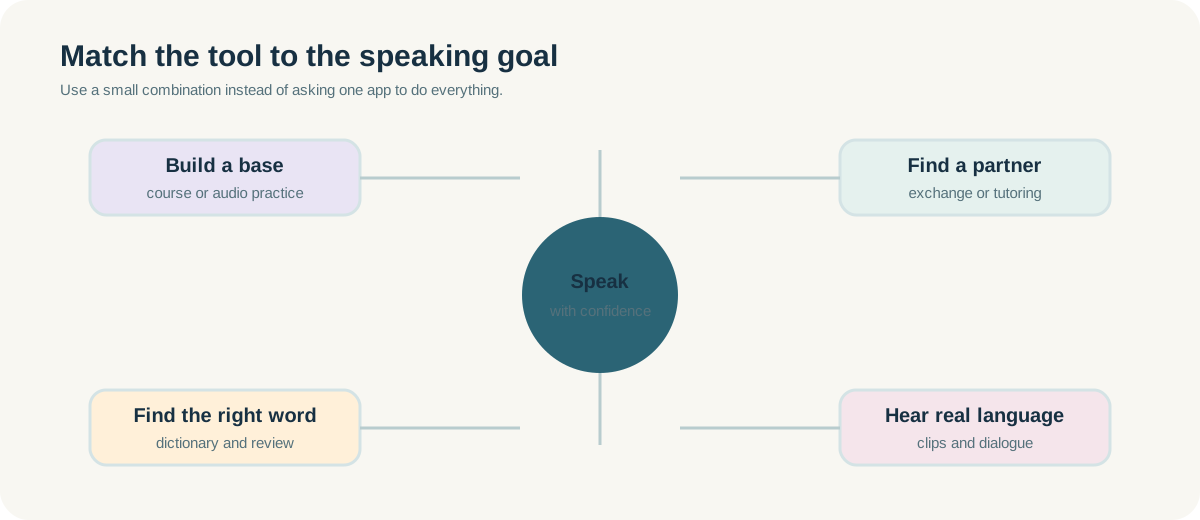
There is no single best tool for learning spoken Mandarin. The right combination depends on whether you need structured lessons, pronunciation practice, real conversations, or more exposure to authentic Chinese.
You can study Chinese for years and still feel uncomfortable speaking it.
You may know thousands of vocabulary words.
You may understand Chinese grammar.
You may be able to read news articles or follow a textbook lesson.
But when someone suddenly asks you a question in Mandarin, you may still have to translate the sentence in your head before answering.
This is a common problem for Chinese learners.
The reason is simple: speaking Chinese is not one skill.
It involves vocabulary, pronunciation, listening comprehension, sentence patterns, automatic recall, and the ability to respond in real time.
That means there is no single app that is automatically the best tool for everyone.
Instead, the best Chinese learning tools solve different parts of the problem.
Here is how I would divide them.
The Best Chinese Learning Tools by Goal

If you want the short answer:
| Your goal | A useful tool |
|---|---|
| Build a structured foundation | HelloChinese |
| Practice speaking and listening | Pimsleur |
| Talk with native speakers | HelloTalk |
| Take personalized speaking lessons | Preply or a private tutor |
| Look up Chinese words and examples | Pleco |
| Learn vocabulary with spaced repetition | Anki |
| Hear authentic Chinese in context | MandarinClips |
The important point is that these tools are not direct replacements for one another.
A learner can use several of them together.
For example:
HelloChinese → Anki → MandarinClips → HelloTalk → Tutor
Each step solves a different problem.
Let’s look at them individually.
1. HelloChinese — Best for a Structured Foundation
HelloChinese is one of the strongest options if you want a structured way to start learning Mandarin.
Its current curriculum covers reading, writing, speaking, vocabulary, and grammar. It also includes speech recognition for pronunciation practice, native-speaker videos, and spaced repetition.
This makes HelloChinese particularly useful for beginners who don’t yet know where to start.
Instead of deciding every day what to study, you can follow a prepared learning path.
Best for
- Beginners
- Structured study
- Vocabulary
- Grammar foundations
- Pronunciation practice
- Character learning
Limitation
A structured course can teach you how Mandarin works, but eventually you also need to deal with Mandarin outside the controlled environment of lessons.
That’s where authentic content becomes increasingly important.
2. Pimsleur — Best for Listening and Speaking Practice
Pimsleur’s Mandarin course takes a different approach.
Its Mandarin program emphasizes listening, pronunciation, comprehension, and speaking. The lessons are designed around spoken language and the company recommends a roughly 30-minute daily routine. Its current Mandarin offering also includes features such as AI pronunciation assistance and role-play exercises.
This makes Pimsleur particularly interesting if your priority is:
“I want to start speaking Chinese.”
The method encourages learners to listen, recall, and respond rather than simply study written explanations.
Best for
- Speaking practice
- Listening
- Beginners who want to speak early
- Learners who prefer audio-based study
- Building automatic responses
Limitation
Audio lessons are useful for building speaking ability, but real conversations are unpredictable.
A real person may interrupt you.
They may use slang.
They may change the subject.
They may speak much faster than the practice material.
Eventually, you need exposure to that kind of language too.
3. HelloTalk — Best for Practicing With Native Speakers
HelloTalk focuses on something language-learning apps cannot completely simulate:
talking to another person.
HelloTalk lets learners communicate with native speakers through text, voice messages, and video. It also offers language exchange, voice rooms, translation, and correction features.
This makes it particularly useful once you are ready to use Chinese with other people.
For example, you might start with text messages.
Then move to voice messages.
Then try short voice calls.
This can create a gradual path from:
writing → speaking → conversation
Best for
- Real conversations
- Language exchange
- Speaking confidence
- Informal Chinese
- Communication with native speakers
Limitation
Language exchange is not the same as a structured lesson.
Your conversation partner may not know how to explain a grammar problem.
They may simply correct your sentence without explaining why it sounds unnatural.
And finding a good, reliable conversation partner can take time.
HelloTalk itself emphasizes matching learners with partners based on goals, interests, schedules, and language levels.
For learners who need systematic feedback, a professional tutor can be a better option.
4. A Private Tutor — Best for Personalized Speaking Feedback
If your main problem is:
“I know what I want to say, but I don’t know how to say it naturally.”
A tutor can be extremely useful.
Platforms such as Preply allow learners to choose Chinese tutors based on goals such as conversational practice, pronunciation, HSK preparation, or general fluency.
A good tutor can immediately notice things an app may miss.
For example:
“Your sentence is grammatically correct, but a native speaker would probably phrase it differently.”
That kind of feedback is difficult to automate completely.
Best for
- Conversation
- Pronunciation correction
- Personalized feedback
- Natural phrasing
- Building speaking confidence
Limitation
A tutor is usually more expensive than an app.
It also requires scheduling and active participation.
And one hour of conversation with a tutor doesn’t necessarily give you enough exposure to a wide variety of speakers and situations.
That’s why combining tutoring with independent listening practice can work well.
5. Pleco — Best Chinese Dictionary and Reference Tool
Pleco is different from the other tools on this list.
It isn’t primarily a speaking course.
It’s a powerful Chinese dictionary and reference application.
The current version includes dictionary search, OCR, handwriting lookup, audio, flashcards, document reading, and other Chinese-learning functions.
This makes Pleco extremely useful whenever you encounter a Chinese word you don’t understand.
For example, while reading or watching something in Chinese, you can quickly look up an unfamiliar expression.
Best for
- Dictionary lookup
- Chinese reading
- Character recognition
- Vocabulary reference
- Checking pronunciation
- Building flashcards
Limitation
A dictionary can tell you what a word means.
It doesn’t automatically teach you how a native speaker would use that word in a particular conversation.
For that, you need examples and context.
6. Anki — Best for Remembering Vocabulary
Anki is useful for a different part of the learning process:
retention.
You can use spaced repetition to repeatedly review vocabulary and sentences at increasing intervals.
This is particularly useful because learning a word once doesn’t mean you will remember it next month.
But there is an important distinction:
Memorizing a word is not the same as learning how to use it.
A flashcard might tell you:
随便 = whatever / as you like
That’s useful.
But it doesn’t necessarily tell you why someone said 随便 in a particular conversation, how their tone sounded, or whether the expression felt polite, dismissive, casual, or frustrated.
For that, you need context.
Best for
- Vocabulary retention
- Spaced repetition
- Long-term review
- Sentence memorization
Limitation
Flashcards are strongest at helping you remember information you already understand.
They are less effective as a substitute for authentic communication.
7. MandarinClips — Best for Authentic Chinese in Context
This is the problem MandarinClips is designed around.
MandarinClips lets Chinese learners search for words and expressions and find short clips from Chinese movies and TV shows where those expressions appear.
The important difference is the starting point.
Instead of:
Watch a movie → find something useful
you can do:
Find something you want to learn → see how native speakers use it.
Imagine you’re learning:
算了
You can memorize:
算了 = never mind
But then you can ask a more interesting question:
How do people actually say 算了?
Is the speaker angry?
Are they disappointed?
Are they giving up?
Are they simply changing their mind?
A short piece of dialogue can provide information that a dictionary definition cannot.
Best for
- Authentic listening
- Chinese expressions
- Vocabulary in context
- Conversational Chinese
- Movie and TV dialogue
- Listening to natural pronunciation
- Understanding tone and emotion
Limitation
MandarinClips isn’t designed to teach every part of Mandarin from zero.
It doesn’t replace a structured course.
It doesn’t replace a tutor.
It doesn’t replace a dictionary.
It solves a more specific problem:
What does this Chinese actually sound like and look like when people use it in context?
So Which Tool Is Actually Best?
The answer depends on what you are trying to improve.
If you are a complete beginner and need structure, start with a comprehensive course such as HelloChinese.
If you want to focus heavily on listening and speaking, Pimsleur is worth considering.
If you need real conversations, try HelloTalk.
If you want personalized correction, work with a tutor.
If you need a Chinese dictionary, use Pleco.
If you struggle to remember vocabulary, use spaced repetition such as Anki.
If you already know Chinese but struggle to understand how words and expressions are used naturally, try authentic dialogue with MandarinClips.
There is no reason to choose only one.
A Better Chinese Learning Stack
Instead of asking:
“Which Chinese learning app is the best?”
a better question may be:
“Which tools should I use together?”
A practical learning stack might look like this:
Step 1 — Build Your Foundation
Use a structured course to learn basic pronunciation, vocabulary, grammar, and sentence patterns.
Step 2 — Remember What You Learn
Use spaced repetition to review important vocabulary.
Step 3 — Look Up What You Don’t Know
Use a dictionary such as Pleco whenever you encounter unfamiliar Chinese.
Step 4 — See It in Real Context
Search for the vocabulary and expressions you’ve learned on MandarinClips.
Listen to several examples.
Compare the situations.
Step 5 — Practice Speaking
Use HelloTalk or a tutor to actually communicate with other people.
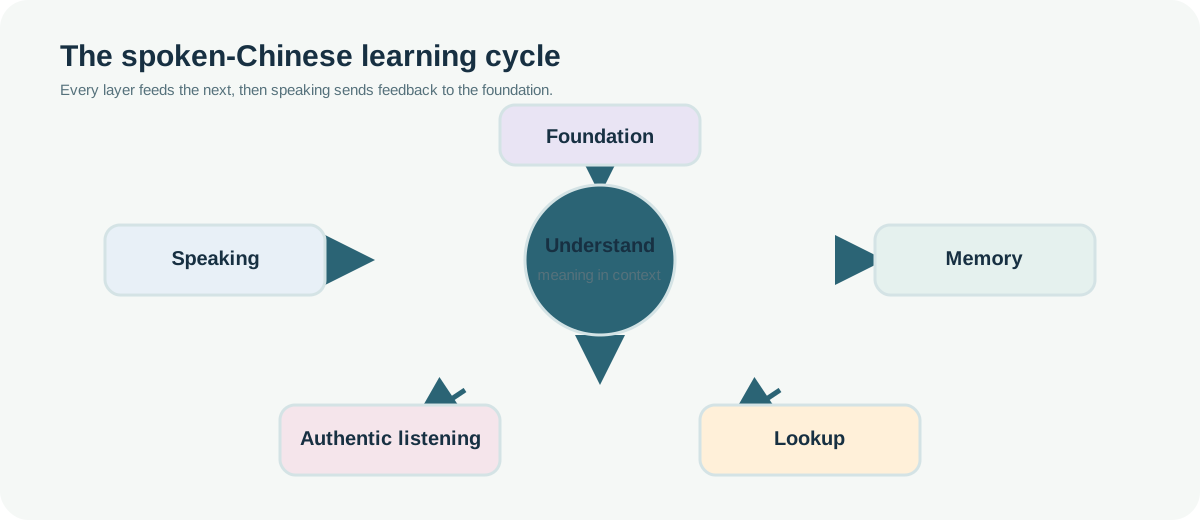
This creates a complete learning cycle:
Learn → Remember → Look Up → Hear → Understand → Speak
Each tool has a different job.
The Missing Layer in Many Chinese Learning Routines
A lot of Chinese learning systems are very good at teaching learners what Chinese means.
They are also good at helping learners memorize vocabulary and practice controlled conversations.
But there is another question:
What does this Chinese sound like when people actually use it?
That question becomes increasingly important as your level improves.
You start noticing that:
- textbook expressions aren’t always the most conversational choice
- dictionary translations don’t always capture tone
- the same word can feel different in different situations
- native speakers use fillers and shortened expressions
- pronunciation changes in connected speech
- context affects meaning
This is where authentic video becomes useful.
You don’t necessarily need more vocabulary.
Sometimes you need to hear the vocabulary you already know used by real people.
The Best Tool Is the One That Solves Your Current Problem
If your Chinese is still at the beginning, don’t worry about collecting ten different apps.
Start with one structured resource.
If you already understand basic Mandarin but can’t speak, increase your speaking practice.
If you can speak but struggle to understand native speakers, increase your listening exposure.
If you understand individual words but struggle with natural expressions, study more Chinese in context.
Your learning tools should change as your problems change.
That’s why there isn’t one universal “best Chinese learning app.”
There is only the tool—or combination of tools—that solves the problem you have right now.
And for many learners, the path from textbook Chinese to natural Chinese requires one additional step:
seeing and hearing the language in real context.