How to Learn Chinese With MandarinClips: A Step-by-Step Guide
A practical method for using real movie and TV dialogue to improve Mandarin vocabulary, listening, pronunciation, and understanding.
Learning Mandarin often starts with a familiar routine.
You learn vocabulary from a course, review flashcards, study grammar, and practice reading Chinese sentences.
At first, this works well.
But eventually, many learners encounter a frustrating problem: they understand Chinese on the page, but struggle to understand it when native speakers actually talk.
A word you know suddenly sounds unfamiliar.
A sentence you understand in a textbook seems much harder in a conversation.
An expression you translated perfectly doesn’t quite make sense in the situation where you hear it.
This happens because knowing a Chinese word is not the same as knowing how that word is used in real communication.
So how can you bridge the gap between learning Chinese and understanding real Chinese?
One practical approach is to study short pieces of authentic Chinese dialogue rather than isolated words and sentences.
MandarinClips makes this process simple: search for a Chinese word or phrase, find it in movie and TV dialogue, watch the clip, study the subtitles, and then listen to the expression in context.
Here’s how to use it.
1. Start With a Chinese Word or Expression
The easiest way to begin is with something you are already learning.
For example, suppose you encounter:
算了
You might already know that 算了 (suàn le) can mean “never mind,” “forget it,” or “let it go.”
But knowing the translation is only the beginning.
You still need to understand questions such as:
- When do Chinese speakers use it?
- Is it casual or formal?
- Can it sound frustrated?
- Does it always mean “never mind”?
- What does it sound like in natural speech?
- What usually comes before or after it?
Instead of immediately looking for another definition, search for 算了 on MandarinClips.
The goal is to move from:
Word → Definition
to:
Word → Real Dialogue → Context → Understanding
That small change can make vocabulary much more useful.
2. Watch the First Clip Without Trying to Analyze Everything
When you find a clip, watch it once without stopping constantly.
Don’t worry if you don’t understand every word.
Your first goal is simply to understand the situation.
Ask yourself:
Who is speaking?
Who are they speaking to?
What is happening?
What emotion does the speaker seem to have?
This matters because Chinese expressions often depend on context.
The same word can feel different when it is said jokingly, impatiently, reluctantly, or seriously.
You are not just learning a word.
You are learning the circumstances in which the word is used.
3. Listen Before Reading the Translation
After watching the clip once, try listening again without relying on the English translation.
See how much you can understand from the sound alone.
This is particularly useful for listening practice.
When learning Chinese, it is easy to develop a habit of recognizing words visually.
You see:
你知道吗?
and immediately understand it.
But when somebody says it quickly, you may not recognize the same sentence.
The solution is not necessarily to learn more vocabulary.
Sometimes you need more exposure to the relationship between Chinese sounds and Chinese words.
Short clips make this easier because you can replay the same piece of dialogue several times.
4. Turn On the Chinese Subtitles
Now look at the Chinese subtitles.
Try to connect what you heard with what was actually said.
For example, you may have heard something that sounded like:
“suàn le”
Seeing:
算了
helps connect the sound to the written form.
This creates an important learning loop:
Listen → Recognize → Read → Listen Again
If you missed part of the sentence, don’t immediately look at the English translation.
Try to understand the Chinese first.
This encourages your brain to process Mandarin directly instead of constantly converting everything into English.
5. Use Pinyin When You Need It
Pinyin can be useful when you know a Chinese character but aren’t sure how it is pronounced.
It can also help beginners connect Chinese characters with pronunciation.
For example:
算了 suàn le
But pinyin should be a support tool rather than something you depend on forever.
As your reading ability improves, try gradually spending more time looking at the Chinese characters themselves.
The goal is eventually to hear:
suàn le
and immediately recognize:
算了
without needing to mentally reconstruct the pronunciation from pinyin.
6. Check the Translation After You Have Tried the Chinese
Translations are useful, but they work best when you use them strategically.
Try this sequence:
First: listen.
Second: read the Chinese subtitles.
Third: think about the meaning from context.
Fourth: check the translation.
This order matters.
If you look at the English translation first, it is easy to understand the English sentence without actually processing the Chinese.
Instead, use the translation to confirm your understanding or explain something you could not figure out.
For difficult expressions, compare the natural English meaning with the Chinese expression.
This can reveal an important fact about language learning:
A Chinese expression and its English translation are not always one-to-one equivalents.
7. Watch More Than One Example
This is one of the most important steps.
Don’t stop after finding one clip.
Search for several examples of the same word or expression.
Why?
Because one example can teach you what an expression means in one situation.
Multiple examples can teach you how the expression behaves across different situations.
Imagine you are studying:
随便 (suíbiàn)
You might encounter it in one situation where it means something like “whatever.”
In another conversation, it could be closer to “up to you.”
In yet another situation, the speaker might be using it in a dismissive or casual way.
The dictionary definition hasn’t necessarily changed.
The context has.
This is why authentic examples are so useful for intermediate and advanced learners.
8. Pay Attention to the Words Around the Expression
Don’t isolate the word you searched for.
Look at the entire sentence.
Then look at the surrounding dialogue.
Suppose you search for:
其实
Instead of memorizing:
其实 = actually
notice what comes before and after it.
You may start seeing recurring patterns such as:
其实我觉得……
其实不是……
我其实……
The goal is to learn more than the dictionary entry.
You want to develop an intuition for how the word fits into a sentence.
This is sometimes called learning vocabulary in context.
9. Pay Attention to Tone and Intonation
Chinese learners often focus heavily on tones at the word level.
That’s important.
But spoken Chinese also has sentence-level rhythm and intonation.
The same words can communicate different attitudes depending on how they are spoken.
For example, a short expression can sound:
- friendly
- surprised
- impatient
- uncertain
- sarcastic
- resigned
depending on the situation and delivery.
Movie and TV dialogue gives you something a written example cannot provide:
the actual voice of the speaker.
When replaying a clip, don’t only listen for individual words.
Listen to:
- pauses
- emphasis
- rhythm
- pitch movement
- speaking speed
- emotional delivery
These details are part of real spoken Chinese.
10. Shadow the Speaker
Once you understand the clip, try saying the sentence yourself.
Play the clip.
Listen to the speaker.
Pause.
Repeat the sentence.
Then play it again and compare your pronunciation and rhythm with the original.
You don’t need to imitate every detail perfectly.
Focus on:
rhythm → pronunciation → intonation → speed
This technique is often called shadowing.
Short clips are convenient for shadowing because you can work with a few seconds of speech rather than an entire conversation.
11. Save the Clips You Want to Review
If you find a particularly useful example, keep it for later review.
The best learning material is not always the most difficult material.
Sometimes a short sentence that you immediately understand is more useful because you can repeatedly imitate it and eventually make it part of your active vocabulary.
Build a small collection of examples that are personally useful to you.
For example:
Expression: 算了
Context: Two people arguing.
Meaning: Forget it / never mind.
What I noticed: The speaker sounds frustrated.
That becomes much more memorable than:
算了 = never mind
on a flashcard by itself.
12. Use MandarinClips Alongside Your Existing Study Tools

MandarinClips doesn’t need to replace your existing Chinese learning system.
In fact, it can work better as one part of a larger routine.
For example:
A structured course can introduce new grammar and vocabulary.
A dictionary can explain definitions and usage.
Flashcards can help you review vocabulary over time.
A tutor or language exchange partner can give you opportunities to speak.
MandarinClips can help you see and hear how Chinese appears in authentic movie and TV dialogue.
Each tool solves a different problem.
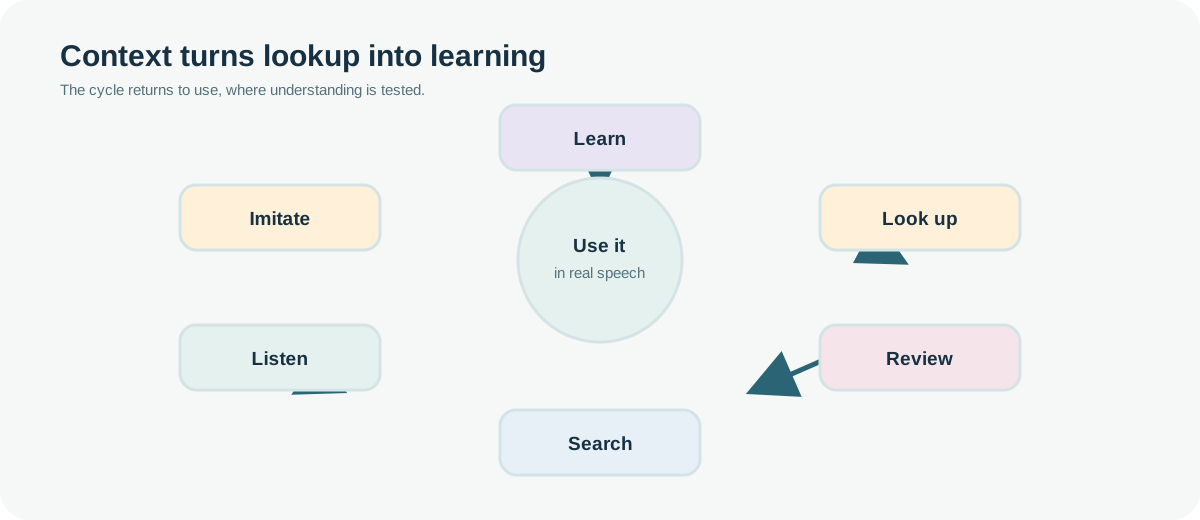
A useful Chinese learning workflow might look like this:
Learn → Look Up → Review → Search → Listen → Imitate → Use
MandarinClips fits into the middle of that process.
A 15-Minute MandarinClips Practice Routine
You don’t need to spend an hour watching movies to practice this way.
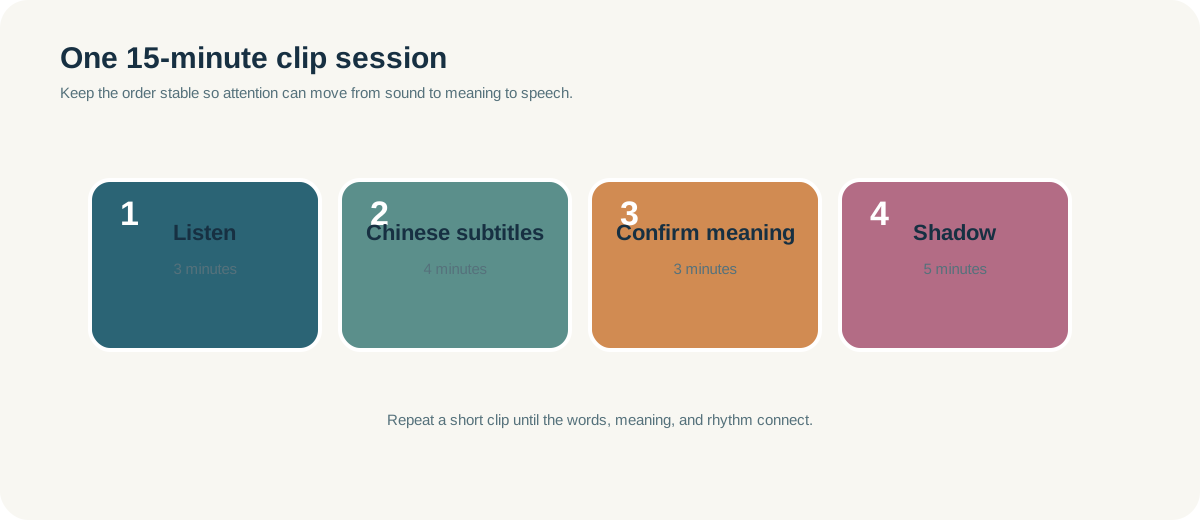
Try a focused 15-minute session.
Minutes 1–3: Choose One Expression
Pick one word or phrase you recently learned.
For example:
原来
Minutes 4–7: Watch Several Clips
Search for the expression and watch several examples.
Don’t worry about memorizing everything.
Look for patterns.
Minutes 8–10: Listen Without Subtitles
Replay one of the clips.
Try to understand the dialogue from sound alone.
Minutes 11–12: Check the Chinese
Turn on the Chinese subtitles.
Identify what you missed.
Minutes 13–14: Check the Translation
Use the translation to confirm your interpretation.
Pay attention to differences between the literal Chinese meaning and the natural English translation.
Minute 15: Shadow the Sentence
Choose one sentence and repeat it several times.
That’s enough for one session.
You can repeat the process tomorrow with another expression.
What Should You Search For?
You don’t have to limit yourself to vocabulary words.
Try searching for different types of Chinese.
Individual Words
For example:
其实
好像
原来
反正
Expressions
For example:
算了
没办法
怎么说呢
真的假的
Grammar Patterns
You can also investigate structures you have encountered in your studies.
Instead of only reading a grammar explanation, look for examples of the structure being used in actual dialogue.
Words You Keep Hearing
This can be particularly useful.
Sometimes you hear a Chinese expression repeatedly but aren’t sure what it means.
Instead of ignoring it, search for it and compare several examples.
You may discover that the expression is much more common in everyday conversation than you realized.
The Goal Is Not to Understand Every Word
One mistake Chinese learners often make is trying to understand 100% of every clip.
You don’t need to.
Real conversations are difficult even for advanced learners.
Instead, choose a small target.
Maybe your target is one expression.
Maybe it is one grammar pattern.
Maybe it is simply understanding one sentence without subtitles.
A short clip can be successful even if you don’t understand everything in it.
The purpose is focused exposure.
Over time, those small pieces of real Chinese start connecting.
From Knowing Chinese to Recognizing Chinese
This is the main reason to practice with authentic dialogue.
There is a difference between:
knowing a word
and:
recognizing that word immediately when somebody says it.
There is also a difference between:
understanding a sentence
and:
understanding why a native speaker chose to phrase it that way.
Those differences become increasingly important as you move beyond beginner Chinese.
MandarinClips is designed around that gap.
It gives you a way to start with something concrete—a Chinese word or expression—and move toward real spoken usage.
Search for the language you are learning. Watch it being used. Listen to it again. Study the context. Then try using it yourself.
You don’t need to watch an entire movie.
You just need one useful piece of Chinese at a time.