How to Learn Mandarin Faster: A Practical Study Plan for Beginners
Learning Mandarin can feel overwhelming.
There are tones to learn, unfamiliar sounds, thousands of Chinese characters, grammar patterns, vocabulary, listening practice, and eventually the challenge of having a real conversation.
For beginners, the natural reaction is often to look for more resources.
You download another app. You save another YouTube playlist. You buy another textbook. You create another vocabulary deck.
After a few weeks, you may have plenty of learning materials but no clear learning system.
The problem usually isn’t a lack of resources.
It is a lack of structure.
If you want to learn Mandarin faster, the goal should not be to study everything at once. The goal is to spend your limited study time on the skills that matter most at your current level.
A good beginner Mandarin routine can be surprisingly simple.
What Does “Learning Mandarin Faster” Actually Mean?
There is no shortcut that makes Mandarin easy overnight.
How quickly you progress depends on several factors:
- How much time you study
- How consistently you study
- Your previous language-learning experience
- Your native language
- Your learning goals
- How much Chinese you hear and read outside your study sessions
But there is an important difference between studying more and learning more efficiently.
Studying three hours once a week is not necessarily better than studying thirty minutes every day.
Language learning depends heavily on repeated exposure.
Your brain needs to see, hear, and use the same language patterns many times before they become familiar.
That means a sustainable daily routine is usually more valuable than an ambitious schedule that lasts two weeks.
Start With Pronunciation
For complete beginners, pronunciation should be one of the first priorities.
Mandarin uses tones, and the meaning of a word can change when the tone changes.
You also need to become familiar with sounds that may not exist in your native language.
Start by learning:
- Pinyin
- The four main tones
- Neutral tone
- Basic initials and finals
- Common tone combinations
- Basic pronunciation patterns
Don’t worry about achieving perfect pronunciation immediately.
Instead, build a reliable foundation.
One common mistake is learning hundreds of Chinese words through written pinyin without spending enough time listening to them.
You want to connect three things from the beginning:
Chinese characters → sound → meaning
For example:
学习 → xuéxí → to study
The written form, pronunciation, and meaning should gradually become one unit in your memory.
Don’t Memorize Vocabulary in Isolation
Vocabulary is essential, but the way you learn vocabulary matters.
Suppose you learn:
吃 — to eat
That’s useful.
But compare it with learning:
你吃饭了吗?
Now you are not only learning the word.
You are seeing how it appears in a sentence.
You are also beginning to learn a conversational pattern.
This is one of the biggest differences between memorizing vocabulary and actually learning a language.
Whenever possible, learn new words together with:
- A sentence
- A common expression
- An example situation
- Audio
- Related words
Context gives your brain more information to connect with the word.
It also makes it easier to recognize the word later when someone uses it in a completely different situation.
Choose One Structured Course

There are now many excellent Mandarin learning apps.
The problem is that having too many choices can become counterproductive.
For a beginner, I recommend choosing one primary structured course.
It could be an app, textbook, online course, or another structured learning system.
The important thing is that it gives you a progression.
You should know what you are learning this week and what you are expected to learn next week.
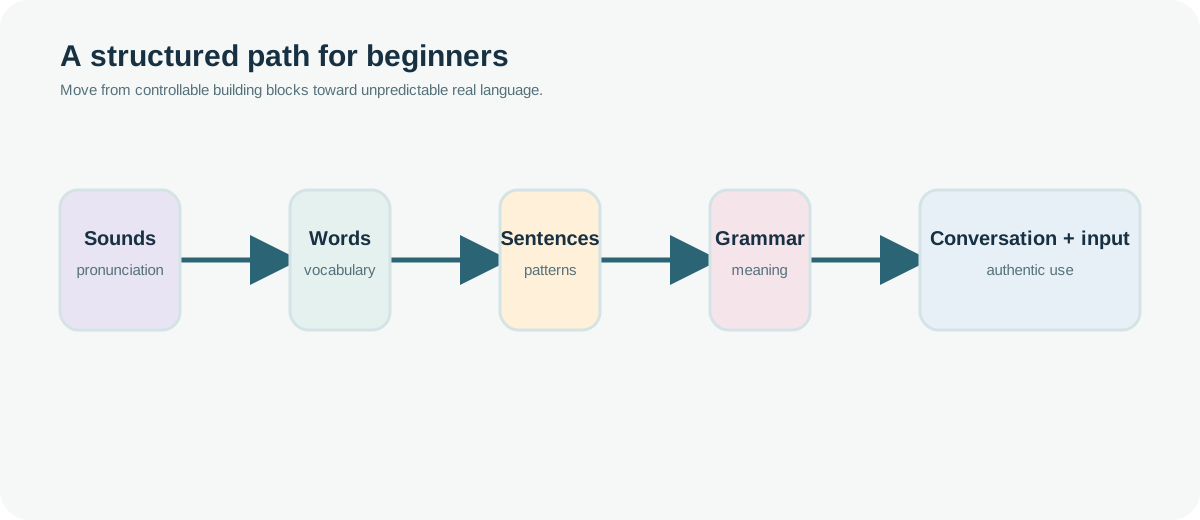
A structured course should gradually take you from:
Pronunciation → Vocabulary → Sentences → Grammar → Conversations
You don’t need five beginner courses at the same time.
Pick one.
Follow it consistently.
Add additional resources only when you discover a specific weakness that your main course does not address.
Start Listening Earlier Than You Think
This is one of the biggest problems beginners encounter.
You can spend months learning vocabulary and grammar and still discover that you cannot understand spoken Mandarin.
That does not mean you failed.
It means that recognizing Chinese on a page and recognizing Chinese in speech are different skills.
Consider the difference between these two situations:
Situation 1:
You see:
你今天怎么样?
You know every word.
Situation 2:
Someone says the sentence quickly during a conversation.
Suddenly, it sounds like one continuous stream of sound.
Your brain needs practice connecting the sound with the words you already know.
That is why listening should begin early.
At first, you may understand very little.
That’s fine.
Your initial goal is not perfect comprehension.
You are training your brain to recognize:
- Mandarin sounds
- Tones
- Word boundaries
- Common sentence patterns
- Speaking rhythm
- Frequently used expressions
Over time, familiar words will start becoming easier to recognize automatically.
Learn From Chinese in Context
This becomes increasingly important once you know the basics.
A textbook can tell you what a word means.
A dictionary can tell you its definition.
A flashcard can help you remember it.
But none of those necessarily show you how people use the word in a real situation.
Imagine learning an expression and then encountering it in a movie.
You hear the pronunciation.
You see the speaker’s facial expression.
You understand what happened immediately before the sentence.
You see what happens afterward.
Suddenly, the expression has a situation attached to it.
That context is valuable.
This is one reason I built MandarinClips.
MandarinClips lets Chinese learners search for words and expressions and find them in short movie and TV clips.
Instead of only asking:
“What does this Chinese expression mean?”
you can also ask:
“How is this expression actually used?”
That distinction becomes increasingly important as you move beyond beginner Chinese.
Use Movies and TV Shows as Listening Practice
You don’t need to watch an entire Chinese movie and try to understand every sentence.
That can be frustrating, especially when you are still learning basic Mandarin.
A better approach is to use short pieces of dialogue.
For example, find a sentence containing a word you already know.
Listen to it.
Read the Chinese subtitle.
Listen again.
Then try to repeat the sentence.
You can gradually remove the subtitles as your listening improves.
This creates a simple learning cycle:
Learn → Find → Listen → Understand → Repeat
The important part is that the material contains Chinese you are already learning.
You don’t want every listening session to feel like decoding an entirely unknown language.
Use Spaced Repetition for Important Vocabulary
You don’t need to put every Chinese word you encounter into a flashcard system.
That can quickly become another source of stress.
Instead, focus on words that are:
- Common
- Useful to you
- Difficult to remember
- Relevant to your current goals
- Appearing repeatedly in your Chinese input
Spaced repetition can then help you review those words over time.
The purpose of vocabulary review isn’t to spend your entire day reviewing flashcards.
It is to make sure important vocabulary doesn’t disappear from your memory.
A good system should eventually make vocabulary easier to recognize in real Chinese.
That is the connection you are looking for:
Flashcard → memory → real-world recognition
Start Speaking Before You Feel Ready
Many learners wait until their Chinese is “good enough” before speaking.
That point never really arrives.
You don’t need advanced grammar to start speaking.
Begin with simple sentences.
Talk about:
- Yourself
- Your family
- Your work
- Your hobbies
- What you did today
- What you want to eat
- Where you want to go
Your first conversations will probably be uncomfortable.
That’s normal.
Speaking is a separate skill from understanding.
You need to train your brain to produce Chinese, not just recognize it.
Mistakes are part of that process.
Don’t Ignore Reading
Chinese characters can make Mandarin feel particularly difficult for beginners.
You don’t need to master thousands of characters immediately.
Instead, learn characters together with vocabulary.
For example:
学
学习
学生
As you encounter related words, the characters begin to form patterns.
Eventually, start reading short Chinese sentences.
Then gradually move toward:
graded content → simple articles → social media → native content
Reading also reinforces vocabulary that you have learned through listening.
The same word appearing in different forms of input gives your brain more opportunities to remember it.
A Simple 30-Minute Daily Mandarin Routine
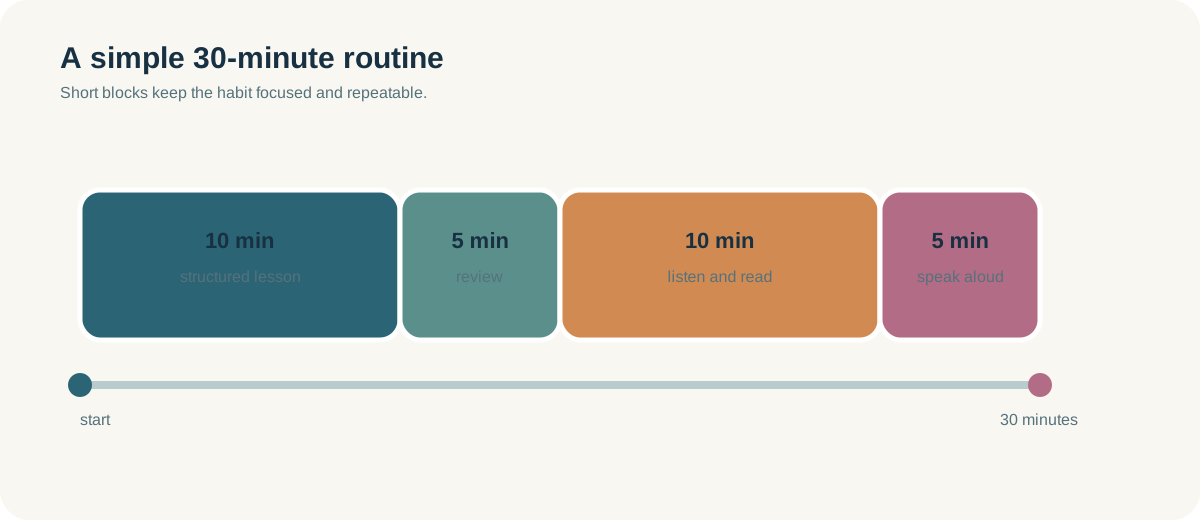
You don’t need to study for several hours a day to make progress.
If you have only thirty minutes, try something like this:
10 minutes — Structured learning
Complete part of your main Mandarin course.
Learn a small amount of new vocabulary and grammar.
5 minutes — Vocabulary review
Review previously learned words.
Use spaced repetition if it works for you.
10 minutes — Listening
Listen to Chinese dialogue.
Try to identify words and expressions that you already know.
5 minutes — Speaking
Repeat useful sentences out loud.
Try to imitate the pronunciation and rhythm rather than simply reading the characters.
That’s enough for a useful daily session.
The key is being able to repeat it tomorrow.
And the day after tomorrow.
A Simple Weekly Study Plan
If you have more time, you can expand the routine.
| Activity | Frequency | Purpose |
|---|---|---|
| Structured lessons | 5–6 days/week | Build your foundation |
| Vocabulary review | Daily | Improve retention |
| Listening | Daily | Improve comprehension |
| Speaking | 3–5 days/week | Build confidence |
| Reading | 3–5 days/week | Improve character recognition |
| Authentic Chinese | Several times/week | Develop contextual understanding |
You don’t have to follow this schedule perfectly.
It is a framework, not a rulebook.
The best study plan is one that fits your actual life.
How Your Study Priorities Should Change
Your learning strategy should change as your Mandarin improves.
Beginner
Focus on:
Pronunciation + basic vocabulary + grammar + simple listening
At this stage, structure is particularly valuable.
Lower Intermediate
Start shifting toward:
Listening + reading + conversation + contextual vocabulary
You should gradually spend more time understanding connected Chinese.
Intermediate
Spend more time with:
Authentic content + conversation + reading + expressions
This is where movies, TV shows, podcasts, books, and conversations become increasingly valuable.
Advanced
Eventually, “studying Chinese” may stop looking like studying.
You might spend most of your time:
- Reading Chinese books
- Watching Chinese shows
- Following Chinese creators
- Listening to podcasts
- Talking with native speakers
- Writing in Chinese
- Learning specialized vocabulary
Chinese becomes part of your environment.
That is a very different stage from completing a language lesson.
The Biggest Mistake Is Trying to Learn Everything
There is an almost unlimited amount of Mandarin learning material online.
You don’t need all of it.
You probably don’t need:
- Ten language learning apps
- Five vocabulary systems
- Three grammar books
- Hundreds of saved videos
- A complicated productivity system
You need a small system that works together.
For example:
One structured course
One vocabulary review system
Daily listening
Regular speaking
Authentic Chinese input
That’s already enough to build a strong learning routine.
Add new resources only when you know what problem they are solving.
A Better Way to Think About Mandarin Learning
Instead of thinking:
“I need to finish this Chinese course.”
Think:
“I need to become better at understanding and using Chinese.”
That changes how you choose your learning activities.
A lesson can introduce a grammar pattern.
A flashcard can help you remember a word.
A Chinese movie can show you how that word sounds in context.
A conversation can force you to use it.
Each activity has a different job.
The goal is to connect them.
Learn the language.
Remember the language.
Hear the language.
Use the language.
That’s how individual pieces of knowledge gradually become language ability.
You Don’t Need a Perfect Study Plan
Learning Mandarin is a long-term process.
There will be days when you study for thirty minutes.
There will be days when you only have five minutes.
There will also be days when you don’t study at all.
That’s normal.
The important thing is to return to the language.
Don’t constantly rebuild your learning system because you missed a few days.
Don’t switch apps every time you discover a new recommendation.
Keep the system simple.
Build a foundation.
Listen to Chinese regularly.
Use vocabulary in context.
Start speaking before you feel completely ready.
And gradually increase the amount of authentic Chinese you can understand.
The fastest Mandarin learning plan is not the one that looks the most impressive.
It is the one you can keep following for the next six months.
Conclusion
There is no single app, textbook, or technique that will make Mandarin suddenly become easy.
A better approach is to build a learning system where different resources solve different problems.
Use structured lessons to build your foundation.
Use spaced repetition to retain important vocabulary.
Use listening practice to connect written Chinese with spoken Chinese.
Use conversations to practice producing the language.
And use authentic Chinese content to understand how the language works outside the classroom.
At some point, you should stop asking only:
“What does this Chinese word mean?”
and start asking:
“How do Chinese speakers actually use it?”
That is where learning Mandarin becomes much more interesting.