

Learning Chinese from a textbook can teach you what a sentence means. But understanding how Chinese is actually spoken is a different challenge.
You may know hundreds or even thousands of Chinese words and still struggle when a native speaker talks to you.
The problem is often not vocabulary alone.
Real Chinese comes with context, natural pronunciation, fillers, hesitation, slang, different tones, and expressions that don’t always translate literally.
MandarinClips is a Chinese language learning platform that helps learners study Mandarin through short clips from Chinese movies and TV shows.
Instead of learning a word only from a dictionary definition or an isolated example sentence, MandarinClips lets you search for Chinese words and expressions and see how they are used in real audiovisual dialogue.
What Is MandarinClips?
MandarinClips is a search and learning tool for people studying Mandarin Chinese.
The basic idea is simple:
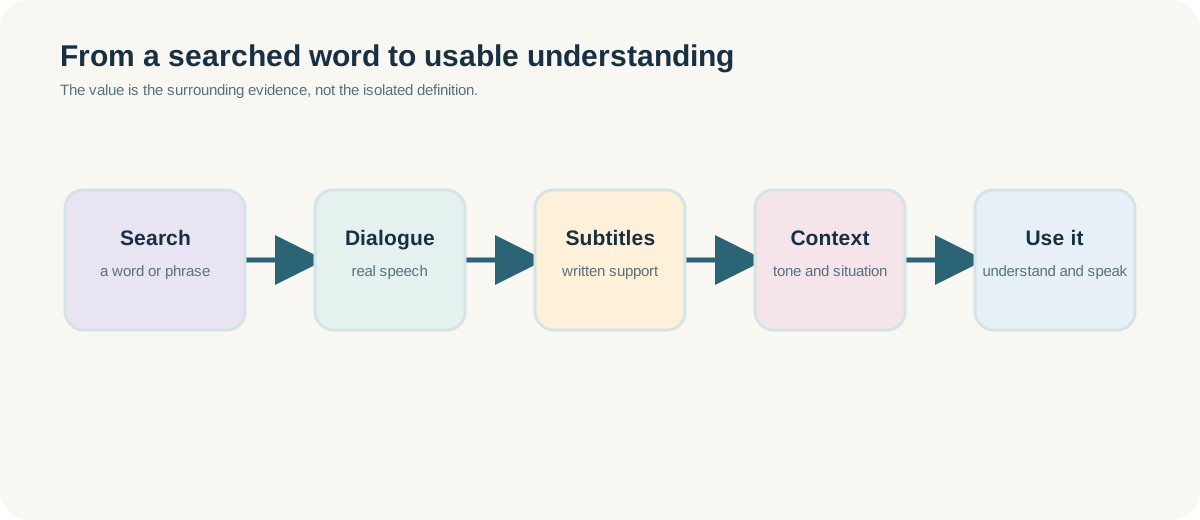
Search for a Chinese word or phrase → find real movie or TV dialogue → watch how it is used → learn the expression in context.
For example, imagine you are learning the Chinese expression 算了 (suàn le).
A dictionary might tell you that 算了 can mean:
- never mind
- forget it
- let it go
- don’t bother
All of these translations can be correct.
But knowing the translations doesn’t necessarily tell you when a Chinese speaker would actually say 算了, what emotional tone it carries, or how it sounds in a conversation.
A short piece of real dialogue can answer those questions much more naturally.
That is the idea behind MandarinClips.
Why Learn Chinese From Movies and TV Shows?
Language learners often encounter a gap between the Chinese they study and the Chinese they hear.
Textbooks need to be structured and easy to understand.
Real conversations don’t.
Native speakers may:
- speak quickly
- leave words out
- use fillers
- repeat themselves
- change their tone
- use informal expressions
- use slang
- interrupt each other
- express meaning through context rather than words alone
Consider the difference between learning:
你在做什么?
and hearing someone casually say:
你干嘛呢?
Both can communicate a similar basic idea, but they belong to different conversational situations.
This difference becomes increasingly important as your Chinese improves.
You eventually need to move from:
“I know what this sentence means.”
to:
“I recognize this when a native speaker says it.”
and eventually:
“I understand why they chose to say it this way.”
Movies and TV shows provide a natural environment for seeing this difference.
MandarinClips Turns Dialogue Into Searchable Learning Material
One of the biggest problems with learning Chinese from movies is finding the exact moment you want to study.
Suppose you want to learn:
- 原来
- 好像
- 随便
- 其实
- 算了
- 赶紧
You could watch an entire movie and wait for one of these expressions to appear.
That isn’t very efficient.
MandarinClips approaches the problem from the opposite direction.
Instead of:
Movie → find useful Chinese
you can start with:
Chinese → find movies containing it
Search for a word or phrase, and MandarinClips can show short clips containing that expression.
This makes authentic Chinese dialogue searchable.
The movie becomes the learning material, rather than simply entertainment.
What Can You Learn With MandarinClips?
MandarinClips can be useful for several aspects of Mandarin learning.
Vocabulary
Seeing a word inside a real conversation can help you understand how it behaves outside a dictionary definition.
For example, learning 不过 (búguò) as simply “but” doesn’t tell you everything about how native speakers use it.
Seeing multiple examples gives you a better sense of its conversational role.
Expressions
Some Chinese expressions are difficult to understand through literal translation.
Expressions such as:
- 算了
- 随便
- 原来
- 好像
- 其实
- 反正
often depend heavily on context.
Real dialogue makes that context visible.
Listening
Listening is one of the biggest challenges for Chinese learners.
Reading a sentence and understanding it does not guarantee that you will recognize the same sentence when somebody says it quickly.
Short clips provide a way to repeatedly listen to the same piece of natural Chinese.
You can listen first, read the Chinese subtitles, check the pinyin or translation, and then listen again.
Pronunciation and Intonation
A translation can tell you what a sentence means.
It cannot fully show you how the sentence sounds.
The speaker’s rhythm, pauses, emphasis and intonation can change how an expression feels.
This is especially important for conversational Chinese.
Grammar in Context
Grammar explanations are useful, but grammar becomes easier to understand when you can see a structure being used in an actual conversation.
Instead of memorizing a rule in isolation, you can observe how native speakers use it.
How Does MandarinClips Work?
The learning process is intentionally simple.
1. Search
Start with a Chinese word or phrase you want to learn.
For example:
算了
2. Explore Real Dialogue
Look through the available clips containing that expression.
You can see how different speakers use the same expression in different situations.
3. Watch the Clip
Play the short video.
Focus on the pronunciation, rhythm, and surrounding dialogue.
4. Read the Subtitles
Use the Chinese subtitles to connect the sound with the written language.
Depending on the available information, you can also use pinyin and translations to help understand the sentence.
5. Compare Contexts
This is one of the most useful parts of the method.
Don’t stop after watching one example.
Watch several examples of the same expression.
You may discover that the same Chinese word can feel quite different depending on:
- who is speaking
- who they are speaking to
- the situation
- their emotional state
- their tone of voice
- the words surrounding the expression
This is something a dictionary definition alone cannot fully communicate.
Who Is MandarinClips For?
MandarinClips is particularly useful for learners who have already started building a foundation in Mandarin and want to understand real-world Chinese.
Beginners
Beginners can use short clips to become familiar with natural Chinese from the beginning.
However, complete beginners may still benefit from a structured Chinese course before relying heavily on authentic dialogue.
Intermediate Learners
This is where authentic dialogue can become especially valuable.
You may already know a large amount of vocabulary and grammar, but still find native conversations difficult to follow.
Searching for familiar words inside real dialogue can help bridge that gap.
Advanced Learners
Advanced learners can use clips to investigate nuance, informal language, slang, pronunciation, and conversational patterns.
At this stage, the question often changes from:
“What does this word mean?”
to:
“Why did this person say it this way?”
Authentic dialogue is particularly useful for that kind of learning.
Chinese Teachers
Teachers can also use real dialogue as supplementary material for lessons about vocabulary, grammar, listening comprehension, and conversational Chinese.
MandarinClips Is Not a Replacement for Every Chinese Learning Tool
MandarinClips is designed around a specific problem:
understanding Chinese in authentic context.
It is not intended to replace every part of a Chinese learner’s study system.
Different tools are good at different things.
A structured course can help you build a foundation.
A dictionary can help you look up unfamiliar words.
Spaced-repetition flashcards can help you memorize vocabulary.
A tutor can provide interactive speaking practice.
MandarinClips focuses on another layer:
*Seeing and hearing how Chinese is actually used in real dialogue.*
In practice, these approaches can complement each other.
For example, a learner might:
- Learn a new word with a structured course.
- Look it up in a dictionary.
- Add it to a vocabulary review system.
- Search for it on MandarinClips.
- Watch several authentic examples.
- Try using the expression in their own conversation.
The goal is not to replace the tools you already use.
The goal is to connect what you have learned with how Chinese is actually spoken.
A Simple Way to Use MandarinClips for Daily Practice
You don’t need to watch an entire Chinese movie every day.
A short, focused session can be enough.
Try this routine:
Choose one expression.
Search for it on MandarinClips.
Watch three different clips.
Pay attention to what changes between the situations.
Listen without reading.
Try to understand the sentence from sound alone.
Turn on the Chinese subtitles.
Check what you heard.
Check the translation only when necessary.
Try to understand the Chinese before relying on English.
Replay the clips.
Listen to the rhythm and intonation.
Try saying the expression yourself.
Copy the speaker’s pronunciation and rhythm.
This turns passive movie watching into active language practice.
The Bigger Idea Behind MandarinClips
The fundamental idea behind MandarinClips is not simply “learn Chinese from movies.”
It is:
*Learn Chinese through real examples of how Chinese is used.*
Movies and TV shows happen to be an excellent source of those examples because they contain dialogue, characters, situations, and emotions.
A learner can move from an abstract vocabulary item to a real situation:
Word → Sentence → Voice → Context → Meaning
That progression can make the language easier to understand and remember.
For Chinese learners, this is particularly useful because many expressions cannot be fully understood through a single English translation.
Context matters.
Tone matters.
The relationship between speakers matters.
And sometimes the surrounding sentence matters just as much as the word itself.
Start With One Chinese Word
You don’t need to change your entire learning system to experiment with contextual learning.
Choose one Chinese word or expression you already know.
Search for it.
Watch a few examples.
Then ask yourself:
*“Do I understand this word better now that I’ve seen how people actually use it?”*
That is the question MandarinClips is designed to help answer.
If your goal is to move beyond textbook Chinese and become more comfortable with the Chinese you actually hear in conversations, movies, and television, authentic dialogue can be a valuable part of your learning routine.