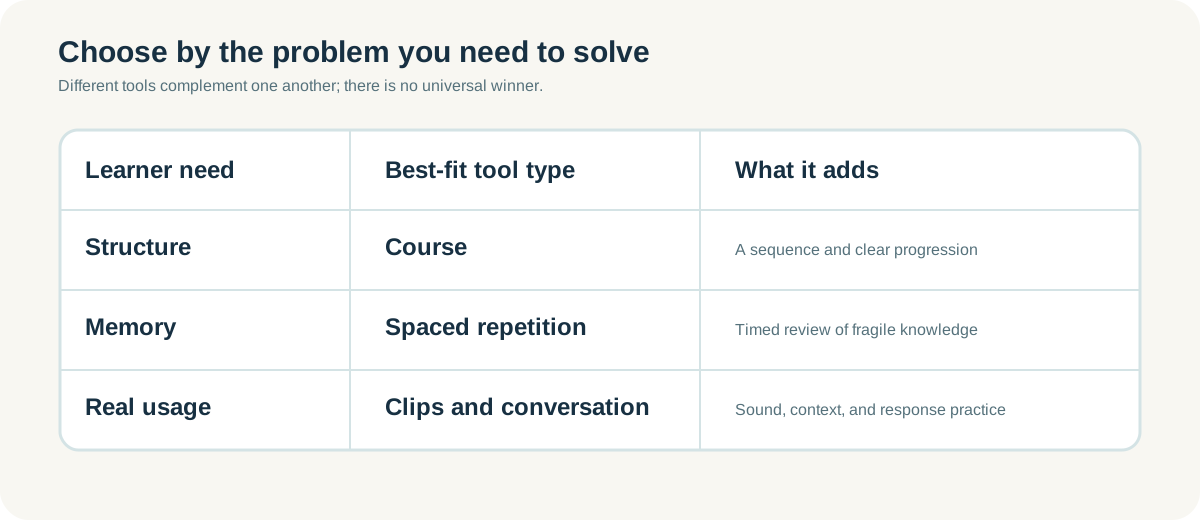
Not every Chinese learning app is designed for the same kind of learner. Here is how to choose the right one for your goals.
Learning Mandarin Chinese has never been easier to start.
There are now apps for almost every part of the learning process: structured courses, vocabulary, pronunciation, grammar, listening, speaking, reading, character writing, and even conversations with native speakers.
But that creates a different problem.
Which Mandarin learning app should you actually use?
The answer depends less on which app has the highest rating and more on what you are trying to improve.
A complete beginner needs something different from an intermediate learner who already knows thousands of words. Someone preparing for a trip to China has different needs from someone trying to understand Chinese movies without subtitles.
So instead of declaring one app the universal winner, this guide looks at the strongest Mandarin learning apps in 2026 and explains what each one is actually good at.
Quick Answer: The Best Mandarin Apps for Different Goals

| App | Best for | Level |
|---|---|---|
| HelloChinese | Complete Mandarin course | Beginner–Intermediate |
| SuperChinese | Structured Chinese study | Beginner–Intermediate |
| LingoDeer | Grammar and structured learning | Beginner–Intermediate |
| Duolingo | Building a daily learning habit | Beginner |
| Pleco | Chinese dictionary and reference | All levels |
| Anki | Long-term vocabulary retention | All levels |
| Du Chinese | Graded Chinese reading | Beginner–Advanced |
| Pimsleur | Listening and speaking | Beginner–Intermediate |
| HelloTalk | Practicing with real people | Intermediate+ |
| MandarinClips | Learning Chinese through real dialogue | Beginner–Advanced |
The important point is that these apps do not really compete for exactly the same job.
In fact, the best Mandarin learning setup may involve several of them.
1. HelloChinese — Best All-in-One App for Beginners
If you are starting Mandarin from zero and want one app to guide you through the basics, HelloChinese is one of the strongest choices.
It combines lessons covering reading, writing, speaking, vocabulary, and grammar with speech recognition, handwriting practice, native-speaker videos, stories, and spaced repetition.
That makes it particularly useful for beginners who don’t yet know what they should study next.
Instead of searching for separate resources for pinyin, pronunciation, vocabulary, and basic grammar, you can follow a structured learning path.
Best for:
- Complete beginners
- Learning pinyin and pronunciation
- Building basic vocabulary
- Learning Chinese characters
- Developing a consistent daily routine
- Learners who want one primary app
One of HelloChinese’s biggest advantages is that it is specifically designed around Chinese rather than treating Mandarin as just another language course.
For someone asking, “I have never studied Chinese before. Where do I start?”, HelloChinese is an easy recommendation.
But there is a limitation.
Structured lessons can teach you a lot about Chinese without necessarily giving you enough exposure to how Chinese sounds in real situations.
Eventually, you need to move beyond exercises.
2. SuperChinese — Best for Structured Chinese Study
SuperChinese is another strong option for learners who want a structured Mandarin curriculum.
Its lessons combine vocabulary, grammar, reading, and exercises, while the app also provides Chinese-specific learning content such as pinyin, characters, HSK-related material, and everyday conversation practice.
The biggest reason to consider SuperChinese is its emphasis on understanding Chinese rather than simply memorizing isolated phrases.
This can be particularly useful if you enjoy learning through a more traditional lesson structure.
Best for:
- Learners who like structured courses
- Grammar-focused learners
- HSK-oriented study
- Learners who want Chinese-specific explanations
- Beginners moving toward intermediate Chinese
SuperChinese and HelloChinese overlap considerably.
The better choice often comes down to which teaching style feels more natural to you.
If one app keeps you studying every day while the other makes you lose motivation after a week, the first app is the better app for you.
3. LingoDeer — Best for Grammar and Structured Learning
LingoDeer is particularly interesting for learners who want more explicit explanations of grammar and sentence structure.
Its Chinese course emphasizes grammar, vocabulary, pronunciation, native-speaker audio, stories, and structured lessons.
This makes it a good choice for learners who often ask:
“Why is this sentence written this way?”
Rather than simply showing you a sentence and asking you to memorize it, LingoDeer puts more emphasis on explaining the system behind the language.
It also has dialogue-based learning content designed to develop conversation skills.
Best for:
- Learners who want grammar explanations
- People who like structured lessons
- Beginners who want to understand sentence patterns
- Learners who prefer explanations over pure gamification
If you have tried several language apps and felt that they taught you phrases without explaining why the language works that way, LingoDeer is worth trying.
4. Duolingo — Best for Building a Daily Habit
Duolingo is probably the most recognizable language-learning app on this list.
Its biggest strength is not necessarily that it teaches Mandarin better than every specialized Chinese app.
Its strength is habit formation.
The short lessons, streaks, rewards, and gamification make it easy to turn language learning into something you do every day.
Duolingo also offers a Mandarin Chinese course using Simplified Chinese characters.
The company has continued updating its Chinese course and has been investing in improving its Chinese, Japanese, and Korean courses, particularly around the difficulty of character-based writing systems.
Best for:
- Casual learners
- People who struggle with consistency
- Beginners
- Learners who enjoy gamification
- Building a daily study habit
However, I would not recommend relying on Duolingo as your entire Mandarin learning system.
Use it to build the habit.
Then add resources that expose you to more Chinese outside the lesson environment.
5. Pleco — Best Chinese Dictionary
Pleco is different from the other apps on this list.
It isn’t primarily a course.
It is a Chinese dictionary and reference tool that many serious Chinese learners eventually end up using constantly.
When you encounter a Chinese word you don’t understand, having a good dictionary available is incredibly useful.
Pleco is particularly valuable once you begin reading Chinese outside your textbook or learning app.
Best for:
- Looking up unfamiliar words
- Reading Chinese
- Character recognition
- Vocabulary research
- Intermediate and advanced learners
For serious Chinese learners, a dictionary app is not optional.
You will eventually encounter words that aren’t in your current lesson, textbook, or vocabulary list.
That’s when a tool like Pleco becomes much more useful than another gamified lesson.
6. Anki — Best for Remembering Vocabulary
Anki is another tool that isn’t specifically a Mandarin course.
Its strength is memory.
The spaced-repetition system allows you to repeatedly review vocabulary at intervals designed to improve long-term retention.
This makes Anki especially useful when you are accumulating a large Chinese vocabulary.
The important distinction is that Anki is mainly a memory tool, not a complete language-learning curriculum.
You still need somewhere to encounter the words in the first place.
A useful workflow is:
Learn → encounter → save → review
For example, you might encounter a new Chinese expression while watching a Chinese TV show, add it to your vocabulary system, and then use spaced repetition to make sure you remember it later.
Best for:
- Vocabulary retention
- Serious learners
- HSK preparation
- Intermediate and advanced learners
- Building a personalized vocabulary database
7. Du Chinese — Best for Reading Practice
At some point, Chinese learners need to stop reading only textbook sentences.
You need to read Chinese written for actual communication.
That is where graded reading apps become useful.
Du Chinese provides reading material at different difficulty levels, allowing learners to gradually move from simple texts toward more advanced Chinese.
Best for:
- Reading practice
- Learners who know basic vocabulary
- Intermediate learners
- Building reading speed
- Learning vocabulary in context
Reading is especially important because Chinese characters create a different learning challenge from alphabetic languages.
Knowing how to pronounce a word does not automatically mean you can recognize it quickly when reading.
Regular exposure matters.
8. Pimsleur — Best for Listening and Speaking
If your main goal is to speak and understand spoken Mandarin, Pimsleur takes a different approach from apps that rely heavily on visual exercises.
Its lessons emphasize listening, pronunciation, comprehension, and speaking.
This can make it particularly useful for learners preparing for real conversations or travel.
Best for:
- Listening practice
- Speaking practice
- Beginners
- Learners who prefer audio-based lessons
- People who want to study while walking or commuting
The downside is obvious:
Audio lessons cannot provide the same amount of visual exposure to Chinese characters and written Chinese.
So Pimsleur works best when speaking and listening are your immediate priorities.
9. HelloTalk — Best for Practicing With Real People
Eventually, you need to use Chinese with another human.
HelloTalk is designed around language exchange, allowing learners to communicate with native speakers through text, voice, and other forms of interaction.
This changes the learning experience completely.
A textbook can tell you how a sentence works.
A real conversation forces you to understand what someone actually says.
Best for:
- Conversation practice
- Speaking confidence
- Informal Chinese
- Learning how native speakers communicate
- Intermediate learners
There is one important caveat.
Language exchange can be intimidating for beginners.
If you only know a few Chinese words, jumping directly into conversations can feel overwhelming.
It usually becomes much more useful after you have built a basic foundation.
10. MandarinClips — Best for Learning Chinese Through Real Dialogue
Most Chinese learning apps have the same basic structure:
Lesson → exercise → answer → next lesson.
That’s useful.
But real Chinese doesn’t happen inside an exercise.
People speak quickly. They shorten sentences. They use fillers. They change their tone. They interrupt each other. They use expressions that textbooks rarely introduce early.
This is where MandarinClips takes a different approach.
Instead of starting with a lesson, you start with real Chinese dialogue from movies and TV shows.
You can search for a word or expression and see it used in an actual scene, with the surrounding dialogue providing context.
That makes it particularly useful for answering questions such as:
- How do Chinese speakers actually use this expression?
- What does this phrase sound like in conversation?
- In what situations would someone say this?
- How does this sentence sound when spoken naturally?
- What does this vocabulary look like in a real scene?
Best for:
- Listening comprehension
- Conversational Chinese
- Learning expressions in context
- Intermediate learners
- Learners who are tired of textbook-only Chinese
- Connecting vocabulary with real situations
MandarinClips isn’t designed to replace a structured beginner course.
Instead, it fills a different gap:
turning vocabulary and grammar you have learned into Chinese you can actually hear in context.
For example, you might learn a new expression in HelloChinese or LingoDeer.
Then you encounter that expression again in a Chinese movie.
That second encounter can make the expression much easier to remember.
So, Which Mandarin Learning App Should You Choose?
There isn’t one winner for everyone.
Your best choice depends on your current problem.
If you are a complete beginner
Start with:
HelloChinese or SuperChinese
You need structure before you need hundreds of resources.
If grammar is your biggest problem
Try:
LingoDeer
Its explanations and structured approach make it a strong option for learners who want to understand how Chinese sentences work.
If you struggle with consistency
Try:
Duolingo
The best learning system is useless if you don’t use it.
If you need a dictionary
Use:
Pleco
Keep it on your phone.
You will probably use it more than you expect.
If you forget vocabulary quickly
Add:
Anki
Use it for long-term retention rather than trying to make it your entire Chinese course.
If you need more reading
Try:
Du Chinese
Graded reading can help bridge the gap between textbook Chinese and authentic written Chinese.
If you mainly want to speak
Try:
Pimsleur + HelloTalk
One gives you structured speaking/listening practice; the other gives you human interaction.
If you want to understand real Chinese dialogue
Try:
MandarinClips
Search for words and expressions and see how they appear in Chinese movie and TV dialogue.
The Best Chinese Learning Setup May Use More Than One App
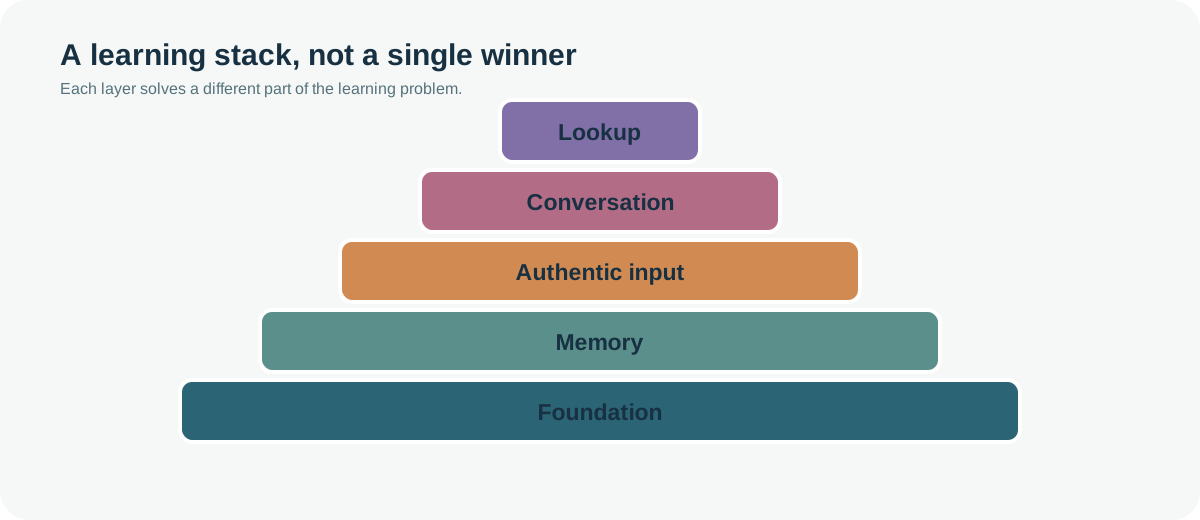
This is probably the most important lesson.
You don’t need to find one app that does everything.
A better approach is to give each tool a specific job.
For example:
HelloChinese ↓ Build your foundation
Anki ↓ Remember important vocabulary
MandarinClips ↓ Hear vocabulary and expressions in real dialogue
HelloTalk ↓ Use Chinese with real people
Pleco ↓ Look up everything you don’t understand
This creates a much more complete learning environment than relying on a single app.
You can think of it as four stages:
Learn → Remember → Understand → Use
A structured app helps you learn.
Spaced repetition helps you remember.
Authentic content helps you understand.
Conversation helps you use the language.
No single app needs to do all four perfectly.
What I Would Recommend for a New Mandarin Learner in 2026
If I were starting Mandarin today, I wouldn’t download ten apps and try to use all of them.
I’d start with three.
1. One structured course
Choose HelloChinese, SuperChinese, or LingoDeer.
2. One vocabulary system
Use Anki if you like spaced repetition and want control over what you remember.
3. One source of authentic Chinese
Start listening to Chinese outside the controlled environment of your course.
Movies and TV are particularly useful because they give you vocabulary, pronunciation, emotion, body language, and situation at the same time.
You don’t need to understand everything.
You just need to start recognizing the Chinese you have already learned when you hear it in the real world.
That is often the point where Mandarin starts to feel less like a collection of vocabulary lists and more like an actual language.
Final Recommendation
The best Mandarin learning app in 2026 isn’t necessarily the app with the most features.
It is the app that solves your current learning problem.
If you need structure, choose a structured course.
If you need vocabulary retention, use spaced repetition.
If you need conversation, talk to people.
If you need reading, read more Chinese.
And if you already know a reasonable amount of Mandarin but struggle to understand how Chinese is actually spoken in everyday situations, start adding authentic dialogue to your learning routine.
Because eventually, the goal isn’t to become good at completing Chinese exercises.
The goal is to understand Chinese when someone actually speaks it.