

Textbooks can teach you the rules of Mandarin. Real dialogue teaches you what those rules sound like in everyday life.
You can spend months learning Mandarin and still experience the same frustrating moment.
You recognize the Chinese characters.
You know most of the vocabulary.
You understand the grammar when you read the sentence.
Then a native speaker says something similar in a real conversation—and suddenly, it feels much harder.
This is one of the biggest transitions in Chinese learning: moving from understanding Chinese as a learner to understanding Chinese as it is actually spoken.
One way to make that transition easier is to learn from authentic Chinese dialogue, including movies and TV shows.
But why are movies and TV shows useful for learning Mandarin? And how should you actually use them without simply watching hours of Chinese television and hoping your Chinese improves?
Let’s look at the difference.
The Chinese You Learn Is Not Always the Chinese You Hear
Textbooks have an important job.
They need to introduce vocabulary clearly, explain grammar systematically, and give learners examples that are easy to understand.
Real conversations have no such requirements.
People interrupt each other.
They hesitate.
They repeat words.
They change their minds halfway through a sentence.
They use shortened expressions.
They speak differently depending on who they are talking to.
They rely on tone and context.
For example, a textbook might introduce:
你在做什么?
Nǐ zài zuò shénme?
“What are you doing?”
That’s a perfectly normal sentence.
But in everyday conversation, you may also hear:
你干嘛呢?
Nǐ gànmá ne?
The basic meaning is similar, but the two sentences don’t necessarily feel identical.
The second expression is much more conversational.
This is the gap that many learners eventually encounter.
You may know the textbook version perfectly and still need more exposure before the conversational version feels natural.
Knowing a Word Is Different From Knowing How It Is Used
Vocabulary is another example.
Suppose you learn:
随便 suíbiàn
A dictionary can give you several translations:
- whatever
- casually
- as you like
- up to you
But which meaning should you use in a particular conversation?
That depends on context.
Imagine someone asks:
你想吃什么?
“What do you want to eat?”
And the other person responds:
随便。
Depending on the situation and tone, this could be understood as something like:
“Anything is fine.”
But imagine the same word being said during an argument.
Now the emotional meaning may feel quite different.
The dictionary definition hasn’t changed.
The context has.
This is why learning vocabulary only as a list of Chinese words and English translations has limitations.
You need to encounter words repeatedly in different situations.
Movies Give You Something a Dictionary Cannot
A dictionary can tell you what a word means.
A textbook can show you how to construct a sentence.
A flashcard can help you remember vocabulary.
But none of these necessarily show you what the sentence sounds like when someone is actually saying it to another person.
A movie or TV scene gives you several layers of information at once:
Words
You can see exactly what was said.
Pronunciation
You can hear how the words are pronounced.
Rhythm
You can hear which parts of the sentence are emphasized.
Context
You can see what is happening.
Emotion
You can observe how the speaker feels.
Relationship
You can see who is speaking to whom.
These details are particularly important for conversational Chinese.
Consider a short expression such as:
好吧 hǎo ba
You could translate it as:
“Okay.”
But hearing a character say it reluctantly, sarcastically, happily, or impatiently can give the expression a very different feeling.
The words are the same.
The communication is not.
Authentic Dialogue Helps You Learn Context
Context is one of the most overlooked parts of vocabulary learning.
Imagine learning:
原来 yuánlái “originally / it turns out / so that’s why”
The English translations are useful, but they don’t completely explain how the expression functions in conversation.
Now imagine hearing it repeatedly in different scenes.
You might notice that:
原来是你。
feels different from:
原来你不知道。
And you may start recognizing the kinds of situations in which Chinese speakers naturally use 原来.
This is a different kind of knowledge.
You’re no longer simply memorizing:
原来 = “it turns out”
You’re developing an intuition for when the expression belongs in a conversation.
That intuition is difficult to obtain from a single definition.
Movies Also Expose You to Informal Chinese
Many learners discover that the Chinese they encounter in real life contains expressions they rarely saw in beginner textbooks.
You may hear:
干嘛
instead of:
做什么
You may encounter:
怎么了?
没事。
算了。
随便。
真的假的?
不是吧?
These expressions are not necessarily difficult because their individual characters are complicated.
They’re difficult because their meaning depends on how they are used.
Movies and TV shows contain thousands of these small conversational moments.
That makes them useful material for learners who want to move beyond textbook Chinese.
But Watching Chinese Movies Alone Is Not Enough
There is an important distinction here.
Watching movies is not automatically the same as studying Chinese.
You can watch two hours of a Chinese drama without actively learning anything new.
You may understand the story.
You may enjoy the characters.
You may even hear a lot of Chinese.
But passive exposure has limits.
A better approach is to turn a small amount of dialogue into focused learning material.
Instead of:
Watch a two-hour movie.
Try:
Find one useful expression → study several examples → listen carefully → understand the context → repeat the sentence.
This is where searchable video clips become particularly useful.
Search for the Chinese You Want to Learn
One of the biggest practical problems with learning from movies is finding useful examples.
If you want to learn the word:
其实
you don’t necessarily want to watch ten hours of Chinese television hoping to hear it.
You want to find the moments where people actually say it.
That’s the idea behind MandarinClips.
MandarinClips lets Chinese learners search for words and expressions and find short clips from Chinese movies and TV shows where those expressions appear.
Instead of starting with a movie and asking:
“What Chinese can I learn from this?”
you can start with the language itself:
“How do Chinese speakers actually use this word?”
That changes the learning process.
Chinese word → real dialogue → context → listening
rather than:
Chinese word → English translation → memorization
Use Multiple Examples Instead of Memorizing One
One of the most useful things you can do with authentic dialogue is compare examples.
Suppose you’re learning:
算了 suàn le
Find several clips containing the expression.
Don’t just ask:
“What does 算了 mean?”
Ask:
“Why did this person say 算了 here?”
Then compare it with another scene.
Perhaps one character says it after an argument.
Another uses it because they have changed their mind.
Another says it because continuing the discussion isn’t worth the effort.
The English translation might be similar in all three cases.
But the situations are different.
That difference is exactly what you want to learn.
Listen Without Looking at the Subtitles
Movies also provide a useful listening exercise.
Try watching a short clip without reading the subtitles.
Ask yourself:
How much can I understand from the audio alone?
Then turn on the Chinese subtitles.
What did you miss?
Maybe you knew all the words but couldn’t recognize them at normal speed.
Maybe the speaker connected several sounds together.
Maybe you weren’t expecting the expression.
Maybe the surrounding context was unfamiliar.
This gives you much more useful information than simply getting a vocabulary question wrong.
You can identify why you didn’t understand.
Then Listen Again
After checking the subtitles, play the same clip again.
This time, the sentence should feel more familiar.
You now know:
- what the speaker said
- what the words mean
- what the situation is
- what the speaker is trying to communicate
That makes it easier to connect the written Chinese with the spoken sound.
A useful cycle is:
Listen → Guess → Read → Check → Listen Again
You can repeat this with a clip that is only a few seconds long.
Pay Attention to Intonation
Chinese learners often spend a lot of time studying the four tones.
That’s important.
But spoken Mandarin also involves sentence-level intonation.
Consider a simple phrase:
真的?
Zhēn de?
The dictionary meaning is roughly:
“Really?”
But the emotional meaning can change depending on how it is spoken.
It might communicate:
- genuine surprise
- disbelief
- excitement
- skepticism
- curiosity
The written characters don’t tell you everything.
The audio does.
This is one reason video can be such useful learning material.
You aren’t only studying what people say.
You’re studying how they say it.
Use Short Clips for Shadowing
You don’t need to shadow an entire movie.
Choose one short sentence.
Listen to it.
Pause.
Repeat it.
Then play the original again.
Try to reproduce:
- pronunciation
- rhythm
- pauses
- emphasis
- speed
The goal isn’t to sound exactly like an actor.
The goal is to become more comfortable producing the same kind of spoken Chinese.
Short clips are especially useful because they make repetition manageable.
You can listen to the same sentence ten times without having to replay an entire scene.
Movies Are Especially Useful for Intermediate Learners
Authentic content can be difficult for beginners.
If you know only a small amount of Chinese, a movie may contain too many unknown words to be useful.
But as your foundation grows, authentic dialogue becomes increasingly valuable.
At the beginner stage, you may ask:
“What does this word mean?”
At the intermediate stage, you may ask:
“Why did they use this expression instead of another one?”
At the advanced stage, you may start asking:
“What does this sentence imply in this particular social situation?”
Movies and TV shows become more valuable as these questions become more important.
You Don’t Have to Abandon Textbooks or Flashcards
Learning Chinese from movies isn’t an argument against structured learning.
Textbooks, dictionaries, flashcards, tutors, and authentic content all serve different purposes.
A structured course can give you a foundation.
A dictionary can explain definitions and usage.
Flashcards can help you retain vocabulary.
A tutor can give you interactive speaking practice.
Authentic video can help you understand how the language sounds and behaves in real situations.
A strong learning system can combine all of them.
For example:
Learn a word → review it → encounter it in real dialogue → listen → imitate → use it yourself
The important thing is to connect these stages instead of treating vocabulary as something that exists only inside a flashcard.
A Simple Method for Learning Chinese From Movies
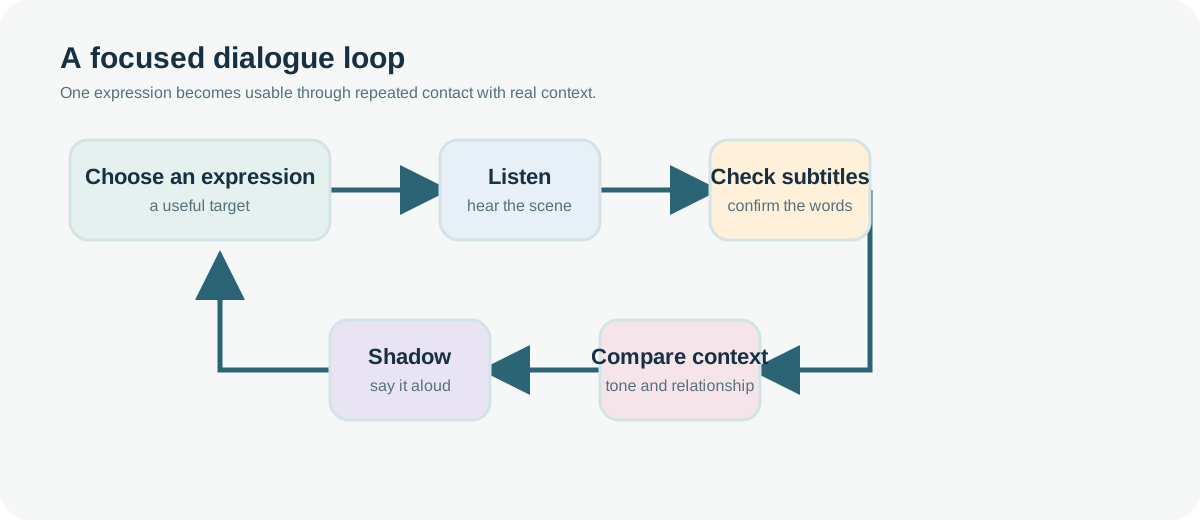
If you want to try this approach, you don’t need to redesign your entire study routine.
Start with one word.
Step 1: Choose a Word
Pick something you recently learned.
For example:
其实
Step 2: Find Real Examples
Search for the word in MandarinClips and find several short clips.
Step 3: Watch Without Analysis
Watch the first clip normally.
Understand the situation.
Step 4: Listen Carefully
Replay it without relying on the English translation.
Step 5: Read the Chinese
Use the Chinese subtitles to check what you heard.
Step 6: Study the Context
Ask why the speaker used that expression in this situation.
Step 7: Compare Another Example
Find another clip and look for similarities and differences.
Step 8: Shadow the Sentence
Choose one useful sentence and repeat it.
Step 9: Move On
You don’t need to master every detail.
Choose another expression tomorrow.
This approach turns movies from passive entertainment into focused learning material.
The Real Benefit Is Context
The biggest reason to learn Chinese from movies and TV isn’t that movies contain “better” Chinese than textbooks.
Textbooks and authentic media serve different purposes.
The real advantage is context.
You can see:
who said something
to whom
where they said it
why they said it
how they said it
what happened before
what happened afterward
All of these details help explain what a Chinese expression actually means in communication.
And that’s something every Chinese learner eventually needs.
Because the goal isn’t simply to know more Chinese words.
The goal is to understand Chinese when real people use those words.
Start Small
You don’t need to watch an entire Chinese movie tonight.
Pick one word.
Find three examples.
Listen carefully.
Read the subtitles.
Compare the situations.
Repeat one sentence.
Then do it again tomorrow.
Over time, you begin to build something that a vocabulary list alone cannot provide:
an intuition for how Chinese actually sounds and works in context.
That’s where movies and TV shows can become more than entertainment.
They can become a source of real Chinese.